


Staring at your bank account and wondering how to create a monthly budget for beginners and where your paycheck went is one of the most common money frustrations out there the fix isn’t complicated, and it doesn’t require a finance degree it starts with one simple tool a monthly budget.
This guide walks you through how to create a monthly budget for beginners, from calculating your real income to tracking expenses, separating needs from wants and building a spending plan you’ll actually stick to.
Table of Contents
Quick Answer
How to create a monthly budget for beginners a written plan that matches your income to your expenses so every dollar has a job. To build one, calculate your total monthly take home income, list your fixed and variable expenses, separate needs from wants, set spending limits for each category and review the numbers at the end of every month.
A simple monthly budget doesn’t need to be perfect on day one. It just needs to be honest.
What Is a Monthly Budget?
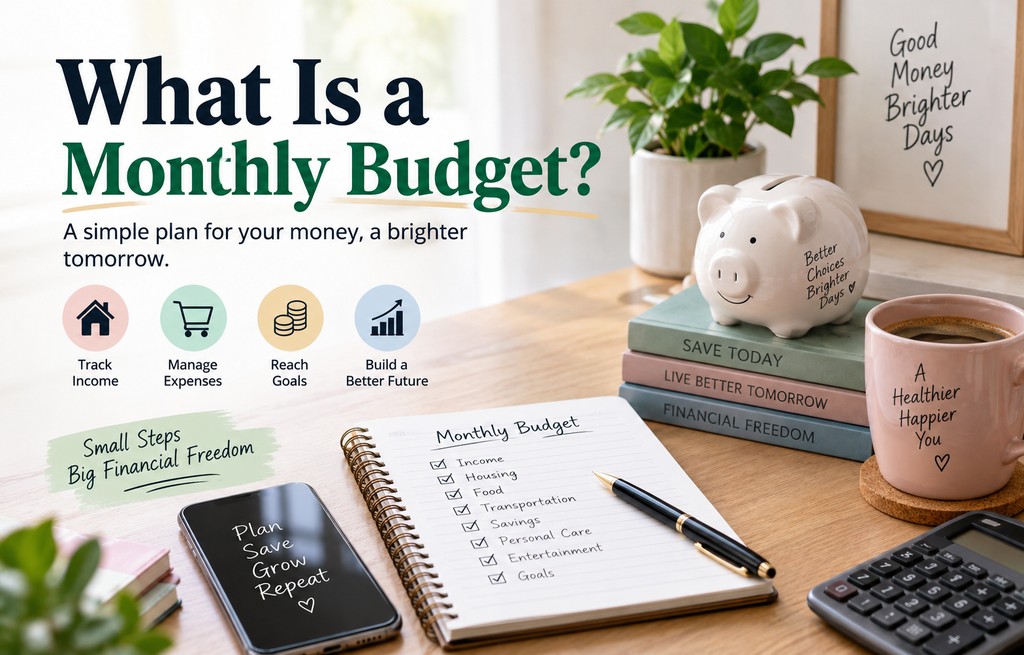
A monthly budget is a plan that shows how much money is coming in and how much is going out over a 30 day period instead of guessing where your money goes you decide in advance how it will be spent, saved or used to pay down debt.
Think of it as a roadmap for your paycheck without one, spending tends to happen on autopilot a coffee here, a subscription there and by the end of the month you’re not sure where it all disappeared to A budget puts you back in the driver’s seat.
For beginners, the goal isn’t to build a complicated spreadsheet with twenty categories it’s to get a clear realistic picture of your money so you can make better decisions with it.
Why Budgeting Matters for Beginners
Personal budgeting for beginners isn’t about restriction it’s about awareness and control a few reasons a monthly budget plan is worth the effort.
- It shows you exactly where your money goes: Most people underestimate their spending in categories like food delivery, subscriptions, and impulse purchases.
- It reduces money related stress: Knowing your bills are covered before payday arrives brings real peace of mind.
- It helps you reach goals faster: Whether that’s an emergency fund, paying off a credit card or saving for a trip, a budget gives you a plan instead of a wish.
- It keeps small leaks from becoming big problems: A $15 subscription doesn’t feel like much, but three or four of them add up over a year.
Budgeting isn’t a punishment for bad spending habits it’s simply a tool that gives you information and information leads to better choices.
Read This Also: Oracle Layoffs 2026: 21,000 Jobs Cut as New Wave Begins
How to Create a Monthly Budget For Beginners (Step by Step)
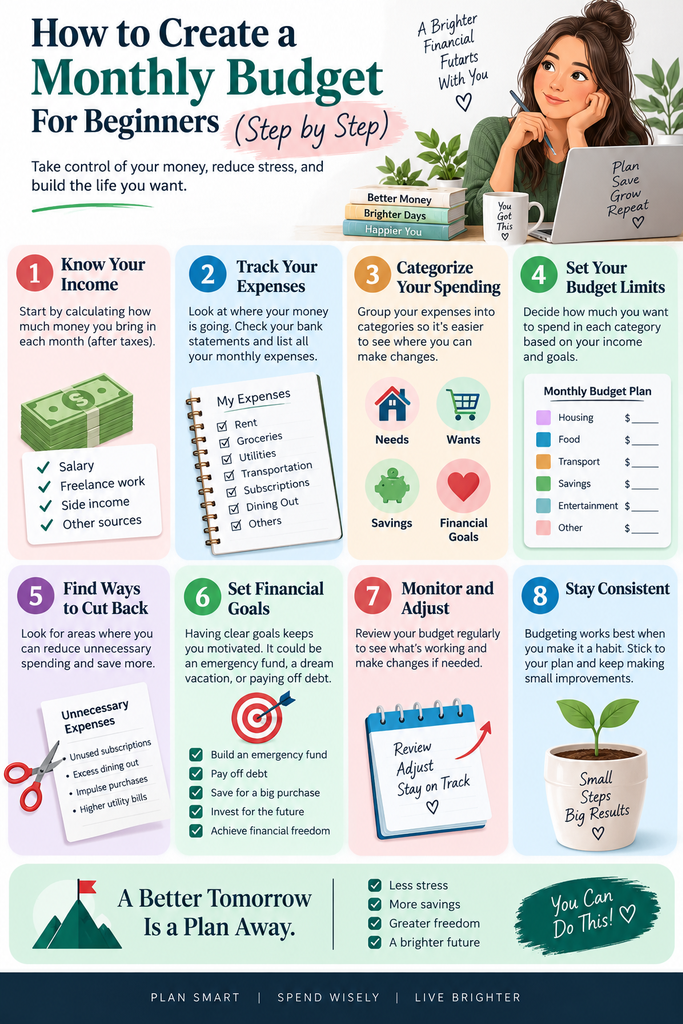
Step 1: Calculate Your Monthly Income
Start with your take home pay, meaning the amount that actually lands in your bank account after taxes and deductions if you’re paid biweekly, multiply your paycheck by 26 and divide by 12 to get an accurate monthly average since some months have three paychecks instead of two.
If you have irregular income, more on that below use your lowest earning month from the past six to twelve months as your baseline.
Step 2: List Your Fixed Expenses
Fixed expenses stay roughly the same every month these typically include:
- Rent or mortgage.
- Car payment.
- Insurance premiums.
- Loan payments.
- Subscriptions with a fixed price.
These are the easiest to budget for because the amounts rarely change.
Step 3: List Your Variable Expenses
Variable expenses shift from month to month. Common examples include:
- Groceries.
- Gas.
- Utilities.
- Dining out.
- Entertainment.
- Personal care.
To estimate these, look back at your last two or three months of bank and credit card statements this is one of the most useful habits when learning how to track monthly expenses accurately, since your memory almost never matches your actual spending.
Step 4: Separate Needs From Wants
A needs vs wants budget is one of the most important beginner budgeting tips out there needs are expenses required to live and work housing, groceries, utilities, transportation, insurance and minimum debt payments.
Wants are everything else: streaming services, takeout, new clothes, hobbies.
Neither category is bad the point is knowing the difference so you can make intentional trade offs instead of accidental ones.
Read This Also : iPhone Duo: Price, Specifications, Features, Camera, Battery Life and Complete Guide
Step 5: Set Realistic Spending Limits
A widely used starting framework is the 50/30/20 approach roughly 50% of income toward needs, 30% toward wants and 20% toward savings and debt payoff.
This isn’t a strict rule it’s a reference point If your rent alone eats up 40% of your income, your percentages will look different and that’s completely normal especially in higher cost-of-living areas.
The goal isn’t matching a formula exactly it’s setting limits you can realistically live within.
Step 6: Budget for Savings First
Try to treat savings like a required expense rather than something left over at the end of the month even a modest, consistent amount like $50 or $100, builds momentum.
An emergency fund covering three to six months of essential expenses is a common long-term target, but starting with $500 or $1,000 is a reasonable first milestone.
Step 7: Handle Debt Payments Deliberately
List every debt with its minimum payment, interest rate and balance pay at least the minimum on everything, then decide whether to put extra money toward the highest interest debt.
First (saves more money over time) or the smallest balance first (builds motivation faster) both are legitimate strategies pick whichever one keeps you consistent.
Step 8: Track Your Spending
Tracking is what turns a budget from a one-time exercise into an ongoing habit you can do this with a notebook, a spreadsheet or a budgeting app what matters is checking in regularly, weekly works well for beginners, so small overspending doesn’t turn into a surprise at month’s end.
Step 9: Plan for Irregular Income and Unexpected Expenses
If your income changes month to month budget based on your lowest expected income and treat anything above that as a bonus to put toward savings or debt for unexpected expenses, a dedicated buffer, even $20 to $30 a month set aside can prevent a flat tire or medical copy from derailing your entire plan.
Step 10: Review and Adjust Every Month
At the end of each month, compare what you planned to spend against what you actually spent adjust categories that were unrealistic a monthly spending plan is a living document not something you set once and forget.
Example of a Simple Monthly Budget
Here’s a realistic monthly budget for beginners based on a $3,500 take home income:
| Category | Monthly Amount | % of Income |
|---|---|---|
| Rent | $1,050 | 30% |
| Groceries | $400 | 11% |
| Utilities | $150 | 4% |
| Car payment & gas | $350 | 10% |
| Insurance | $150 | 4% |
| Minimum debt payments | $200 | 6% |
| Subscriptions & entertainment | $100 | 3% |
| Dining out | $150 | 4% |
| Personal care & misc. | $150 | 4% |
| Emergency savings | $300 | 8.5% |
| Extra debt payoff | $200 | 5.5% |
| Flexible/buffer fund | $300 | 8.5% |
| Total | $3,500 | 100% |
Your own numbers will look different depending on your income, location and obligations this table is meant as a starting template not a rulebook.
Read This Also: 8 Ways to Borrow Money Fast
Tips for Sticking to Your Budget
- Automate what you can: Set up automatic transfers to savings right after payday so the money is gone before you’re tempted to spend it.
- Use a budgeting app for beginners: Tools like YNAB, EveryDollar, Goodbudget and your bank’s built in budgeting features can simplify tracking many offer free versions that are more than enough to start.
- Build in a small fun money category: A budget with zero flexibility rarely lasts a little breathing room makes it sustainable.
- Check in weekly not just monthly: Short, frequent check-ins catch problems early.
- Expect imperfection: Almost no one nails their budget on the first try. Adjust and keep going.
Common Budgeting Mistakes to Avoid
- Being too restrictive too fast: Cutting every non-essential expense at once usually backfires.
- Forgetting irregular expenses: Annual costs like car registration or holiday spending need their own monthly savings line.
- Not tracking spending at all: A budget without tracking is just a guess.
- Giving up after one bad month: One overspent category doesn’t mean the system failed it means it needs an adjustment.
- Copying someone else’s budget exactly: Your income, city and obligations are unique use examples as a guide not a template to follow blindly.
Conclusion
Learning how to create a monthly budget for beginners comes down to a few honest steps know your income, know your expenses, separate needs from wants and check in regularly it won’t be perfect the first month and it doesn’t need to be what matters is building the habit of telling your money where to go instead of wondering where it went.
How do I create a monthly budget?
Calculate your take home income, list your fixed and variable expenses, separate needs from wants then assign a spending limit to each category so your total spending doesn’t exceed your income.
Set aside money for savings and debt first, track your spending through the month and adjust as needed. The 50/30/20 rule (50% needs, 30% wants, 20% savings/debt) is a simple starting framework.
Can ChatGPT make me a budget?
Yes, ChatGPT can help you build a basic budget if you give it your income and expenses but it can’t access your bank accounts or track your spending automatically.
You’ll still need to gather your own numbers and any budget it generates should be treated as a starting template to customize not personalized financial advice.
How do I ask someone about their budget?
Keep it casual and non-judgmental rather than putting them on the spot something like, “How do you usually plan out your spending each month? or “Do you follow a budget or just keep an eye on things as you go?” works well.
Avoid asking about specific numbers (like their income or debt) unless the relationship and context make that appropriate the goal is to open a conversation not audit their finances.
How to help someone create a budget?
Start by understanding their goals and current habits rather than jumping straight to numbers help them list their income and expenses, then walk through separating needs from wants together.
Suggest a simple framework like 50/30/20 as a starting point but let them set limits that fit their actual life offer support with tracking tools or check-ins and avoid being judgmental about past spending the goal is to build a system they’ll stick with, not point out mistakes.
What are the 5 basics to any budget?
Every budget comes down to five core elements income (what you actually bring in) fixed expenses (costs that stay the same each month, like rent) variable expenses (costs that change, like groceries and gas), savings (money set aside for goals or emergencies), and debt payments (money going toward what you owe).
Balancing these five pieces so your spending doesn’t exceed your income is the foundation of any budget, simple or complex.
What are the 7 steps to creating a budget?
1. Calculate your monthly take-home income
2. List your fixed expenses (rent, insurance, loan payments)
3. List your variable expenses (groceries, gas, entertainment)
4. Separate needs from wants
5. Set spending limits for each category
6. Set aside money for savings and debt payments
7. Track your spending and adjust the budget each month